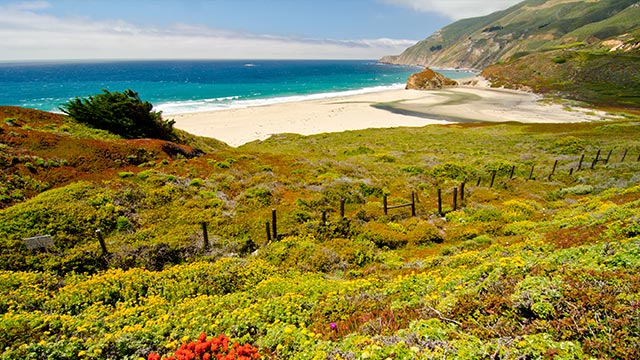
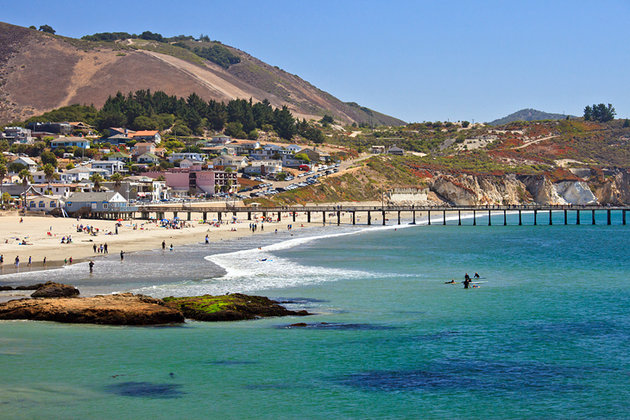
San Luis Obispo is one of the hidden gems of the California central coast. Located roughly about half way between Los Angeles and San Francisco, San Luis Obispo or SLO sits eleven miles inland from the Pacific and features a cool Mediterranean-like climate. As the home to California Polytechnic State University or Cal-Poly, San Luis Obispo is the local cultural mecca for music, arts and dining.
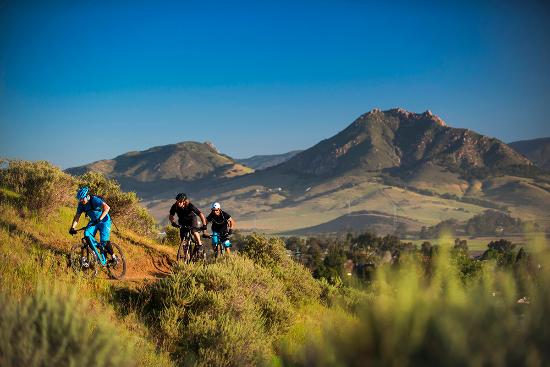
 “Consistently acclaimed as one of the top ten places to live in the United States, visitors will find plenty to do in San Luis Obispo. SLO boasts many excellent golf courses, plenty of vineyards, miles of surfable coast line, low traffic roads or aggressive single track trails for biking, dozens of hiking trails, great ocean and lake fishing, several hot springs and spa choices, incredible dining and lodging options, and thousands of nooks where you can just enjoy nature and leave the daily grind behind.” [1]
Like almost all the major central coast cities, SLO was originally settled by the Chumash over eleven thousand years ago. [2] The modern city was founded in 1772 by Spanish Franciscan Junípero Serra, San Luis Obispo is one of California’s oldest communities. Serra’s original mission was named for the 13th Century saint and bishop Louis of Toulouse and locally referred to as San Luis.
THE MISSION SAN LUIS OBISPO DE TOLOSA

“On September 1, 1772 a cross was erected near San Luis Obispo Creek and Father Junípero Serra celebrated the first mass, marking the site as the destination for the mission San Luis Obispo. The Chumash helped construct wooden  palisades, which would serve as temporary buildings for the Mission. However, due to several Indian tribes which were determined to get rid of European settlers, they set these buildings ablaze. Because of this, the Spanish were forced to rebuild the buildings using adobe and tile structures.”
“The mission San Luis Obispo was part of a string of missions in California which were created in order to control the coast so that the ships from Spain would remain safe as well as bring the native people to the Catholic faith. At the missions, the Spaniards introduced native people to the European lifestyle and taught them their religious beliefs as well as Spanish and Latin for services, how to read music, sing as well as how to be skilled weavers, seamstresses, carpenters, tile makers, farmers and cattle herders. The original mission church is still standing and operation. You can visit and see its unusual L-shaped design that is found nowhere else among the California missions.”
THE FESTIVAL OF BEERS
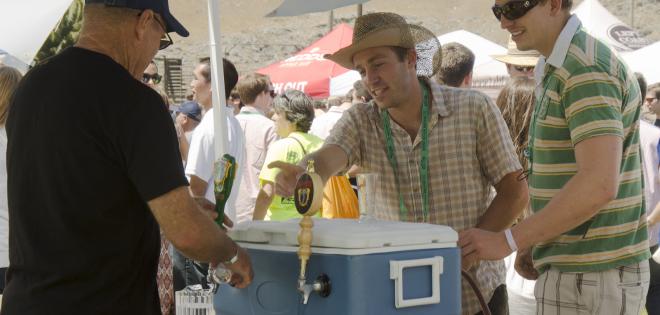
 Every year, San Luis Obispo hosts the California Festival of Beers Its one of the largest and is the oldest regional beer festivals in California. Held on Memorial day weekend the festival is celebrating its 31st anniversary this year. The Festival is a benefit event managed and
 maintained by Hospice of San Luis Obispo County (Hospice SLO County), a non-profit grief counseling organization, and receives 100% of the proceeds.
The California Festival of Beers brings together live music, local foods, art viewing and a wide selection of beers than ever before. At “Arts and Drafts,” attendees will learn from the beer pairing master Dr. Bill Sysak, beverage coordinator of Stone Brewing World Bistro & Gardens and a recognized figure of the craft beer community.
 “This event has had amazing growth and support over the years and it is a major source of income for Hospice SLO that allows us to continue to provide free services to the community,” said Executive Director Kris Kington-Barker. “We could not manage this without the backing of the brewers, sponsors, vendors and hundreds of volunteers who make this happen every year.”
Over 4,000 attendees each year to California’s Central Coast. Because of the event’s popularity, it sells out each year. The Festival features over 50 brewers who present their micro brewed creations. Admission includes a souvenir beer glass, unlimited samples of offerings, and free shuttle service. There’s also live music and a variety of food stands that offer all the delicious food you can think of that goes with beer.
For a truly fun time don’t miss the amazing California Festival of Beers.
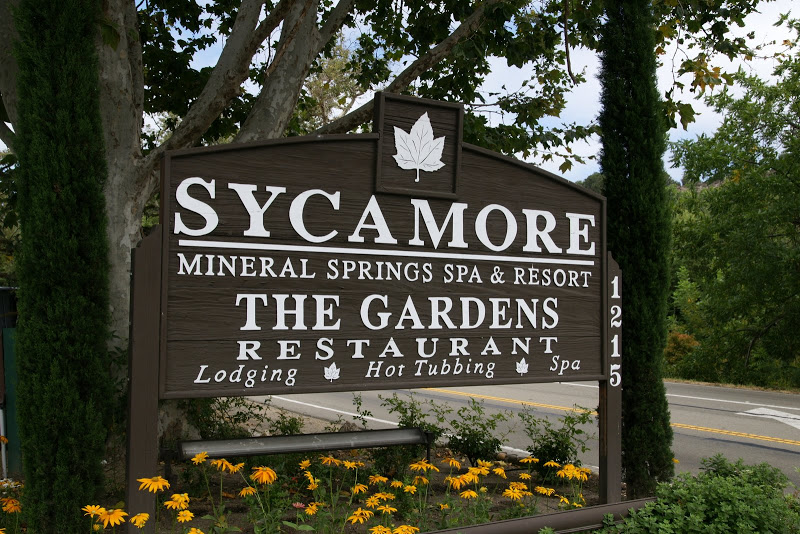
SYCAMORE SPRINGS MINERAL RESORT
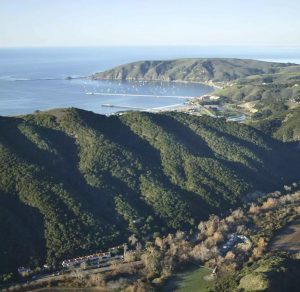
 One of the hidden gems of the California Central Coast is the Sycamore hot springs, which is nestled in the pristine Avila Valley about 7 miles west of San Luis Obispo. The story goes that in 1886 two prospectors were drilling for oil when they hit an artesian well of white hot mineral water. Since then the a popular spa and mineral springs resort has grown around the discovery. Since the late 19th century, due to the healing powers of the water, a popular spa and mineral springs resort was established. The beginning of the 20th century brought weary travelers from Los Angeles and San Francisco via the Pacific Coast Railway. By the 1930’s, word of the healing waters spread to Hollywood celebrities who would frequent the resort on their way to rub elbows with William Randolph Hearst at his magnificent castle just down the road in San Simeon. Around this time, the increasingly popular retreat was given the name, “Sycamore Mineral Springs Resort.”
 Located on over 100 wooded acres, the Sycamore Mineral Springs Resort’s most defining feature is the restorative power of the naturally heated mineral water. The resort has a variety of mineral baths including the unique Oasis Waterfall Lagoon, a scenic hillside hot tub, or a private guest room tub. All of the 72 guest rooms include individual hot mineral spring tubs on private balconies or patios.
There are also 23 open-air naturally heated mineral spring hot tubs open to the public, that line the peaceful tree-canopied hillside. Each hot tub is surrounded by a beautiful rich wood fence with lattice detail to ensure privacy from other guests while still providing majestic views and a serene environment.
Innovative healing arts classes are taught by a selected staff of professional instructors. “Strengthen, stretch, calm, and rejuvenate your way to a better you.” The instructors are dedicated to the art of healing. Their teachings embrace the connection between the mind, body, and spirit and you will find they are genuine extensions of everything they teach. Daily classes feature Yoga, Pilates, Tai Chi, and more. All classes are open to the public and priced per session, per person. Resort guests receive unlimited complimentary classes. Private instruction 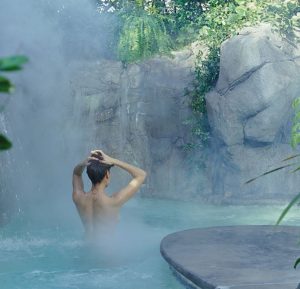 available upon request.
The Sycamore Mineral Springs Resort has been voted a top global destination mineral spring resort by Spa and Spa Finder magazines. The spa treatments are designed to enliven your senses while providing you with healing benefits sourced from nature. For example: “The Hot Springs Stone massage blends traditional massage techniques with heated basalt stones to penetrate tension and improve circulation with warmth and comfort to ease your stressed muscles. The White Algae Facial is ideal for sensitive or dry skin and uses calcium rich white algae, white tea, and copper peptides to calm and soothe irritated skin while evening out skin tone. The Sundaria Seaweed Body Scrub detoxifies with a full body dry brush exfoliation and  organic bio-scrub blend of seaweed, pumice, acai and guarana to polish skin and purify pores. A marine-based oil filled with sea minerals and antioxidants leaves skin hydrated and repaired. The dry brush is given as a gift so you can continue your detoxifying treatments at home.”
“The highly acclaimed, Gardens of Avila Restaurant is widely known for its seasonal and spontaneous garden cuisine.” The menu includes local seafood like the Morro Bay fish and chips with local rock fish fried in beer batter, French fries, house made coleslaw and lemon aioli; Local Artisan Cheese Plate with Central Coast Creamery‘s sea scape & bishops peak, fiscalini bandage white cheddar, local honey, toasted almonds, local berries and local salami (optional). There are intimate settings for indoor and outdoor dining. The restaurant features produce harvested on the resort’s one-acre organic Chef’s Garden as well as local farmers markets.
THE SAN LUIS OBISPO WINE CONTRY
 “Winemaking is deeply rooted in SLO Wine Country, dating back to the 18th century with the founding of Mission San Luis Obispo by Father Junipero Serra in 1772.” [1] Here, the padres grew grapes and made them into sacramental wines. A century later, commercial wine was produced from grapes grown at Rancho Saucelito in the upper Arroyo Grande Valley. The old Zinfandel vines planted in 1880 by Henry Ditmas were restored by the Greenough family in the 1970s, and remain a cornerstone of Saucelito Canyon Vineyard.
 The modern wine industry in the SLO Coast emerged in the 1970s. In 1973, the Goss family had the foresight to plant Chardonnay at Chamisal Vineyard in the Edna Valley. Concurrently, the Niven family planted Pinot Noir, Chardonnay and other varietals at Paragon Vineyard. MacGregor Vineyard was planted in 1976 and is now the home of Wolff Vineyards. The success of these early plantings of Chardonnay and Pinot Noir ignited SLO Wine Country’s reputation as a world-class region for Burgundian varietals.
In 1979, Lawrence Winery was established as the region’s first modern winery, and the property is today home to Center of Effort Winery. Chamisal Vineyard began making its own wine in 1980, and Edna Valley Vineyard followed in 1981 as a partnership between Paragon Vineyard and Chalone Vineyard. Claiborne & Churchill Winery, Maison Deutz (now Laetitia Vineyard & Winery), and Talley Vineyards soon added further momentum to the local winemaking scene. These early wineries paved the way and put SLO Wine Country on the map.
SLO Wine Country includes two small adjoining American Viticultural Areas—the Edna Valley and Arroyo Grande Valley—and other nearby wine growing areas. Each of these areas shares a unifying proximity to the ocean, as well as to each other.
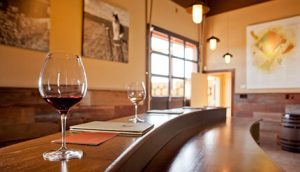 The Arroyo Grande Valley is a predominantly northeast-southwest oriented coastal valley that is recognized as one of the most temperate viticultural areas in the world. These ideal conditions result in a long and mild growing season, with bud bread typically occurring in mid-February, flowering in early May and harvest in late September. Still widely planted to vegetables on the valley floor, wine growing in the valley dates to the 1880’s when Zinfandel was planted in the warmer eastern part of the valley. The modern era began in the 1980s with plantings of Chardonnay and Pinot Noir on the hillsides of the western end of the valley, closer to the coast.
 San Luis Obispo Sycamore Mineral Springs Resort and Spa is centrally located for exploring Edna Valley, Arroyo Grande, Avila Valley, and Paso Robles wine regions. There are numerous excellent wine tours available, with pick-up at our resort. Onsite wine experiences are also available so you don’t have to leave the premises to enjoy award-winning central coast excellence.Whether you are a wine novice or happen to be a sommelier, everyone will enjoy the wine tasting opportunities throughout the Central Coast. In 2013 our area was awarded “World’s Best Wine Region” by Wine Enthusiast magazine.
The philosophy that exceptional wines can be approached by all tasters shines bright in over 450 wineries from Arroyo Grande to Paso Robles. Intimate tasting rooms, beautiful outdoor areas, and laid-back settings invite you to discover your ideal wines.
San Luis Obispo, with its heritage, festivals and points of interest, is a wonderful place to visit. Next time you’re looking for an unusual place to visit, treat yourself and the family to a magical time, bath in the hot springs, visit a winery and enjoy the many picturesque hikes and natural wonders of San Luis Obispo.
Brought to you by Kaz Headrest. Travel in comfort with a Kaz Headrest. Available on


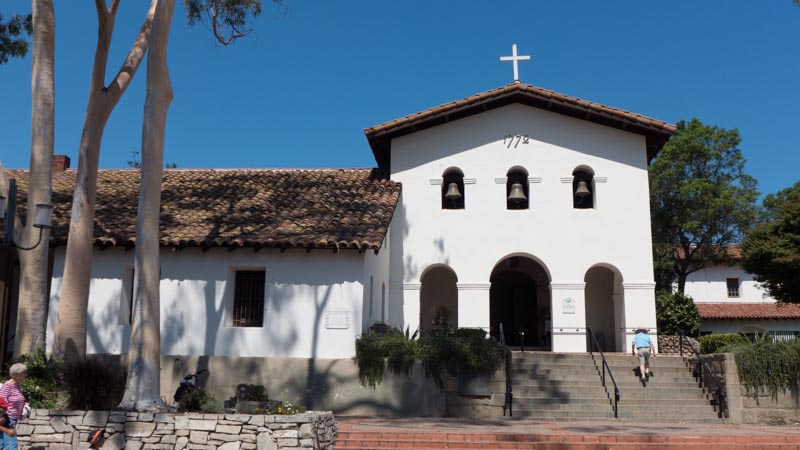


 to the valley has been celebrated through the years and many believe today that Ojai is a ‘vortex’ – an unseen force that concentrates energy. Some equate this vortex to the valley’s unusual positioning in the mountain range that runs east to West and that this helps concentrate geological tremors and atmospheric energy. Others point to geology and that the stratified mountain rocks inlaid with quartz can harness energy, transmitting it along the lines of the vortex.”
 Duke spent a lot of time in Southern California throughout the 1910’s and 1920’s. The Southland was equally charmed with Duke and he made many friends there and was a particular favorite of the movie colony.
 festival of performances by some of the world’s top musicians and composers, and occurs on the first weekend after Memorial Day. Notable appearances include Igor Stravinsky, Aaron Copland, Esa-Pekka Salonen and Pierre Boulez, who was festival director in 2003. “Curious audiences gather at the Ojai Music Festival each year for a transcendent musical communing in the beautiful Ojai Valley. Every Festival follows the lead of a new music director, accommodating wildly different styles and approaches.” In 2017, the festival is being conducted by Grammy-nominated composer-pianist Vijay Iyer (pronounced “VID-jay EYE-yer”). He is “one of the most interesting and vital young pianists in jazz today,” and has been voted DownBeat Magazine‘s Artist of the Year three times. He is a professor of the arts in the Department of Music at Harvard University. This should make this year’s festival lively and modern.
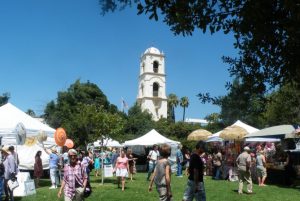 Its official, June is lavender month in Ojai and the
 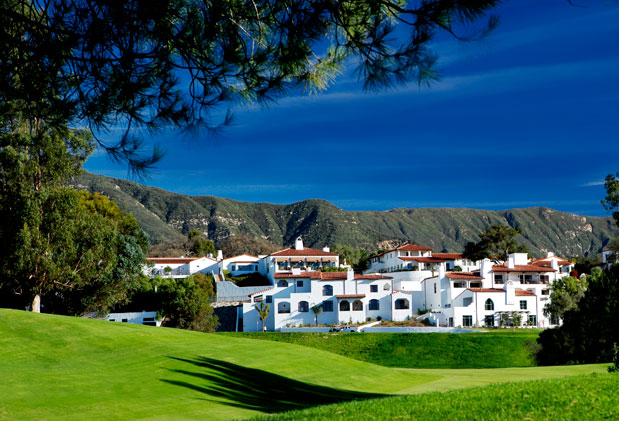 “Ever since returning to private ownership in 1947, the Ojai Valley Inn & Spa has played host to countless celebrities from nearby Hollywood and an impressive roster of golf pros who return year after year to play the historic course. In 1999, the acclaimed golf course was restored, which included the return of two “lost” signature holes. In 2004, an extensive renovation was completed which upgraded every corner of the resort while maintaining the historical integrity of the property.”
 GOLF
GOLF golfer could enjoy his round without too great a penalty, and that a test must be afforded requiring the low-handicap man to play fine golf in order to secure pars.”
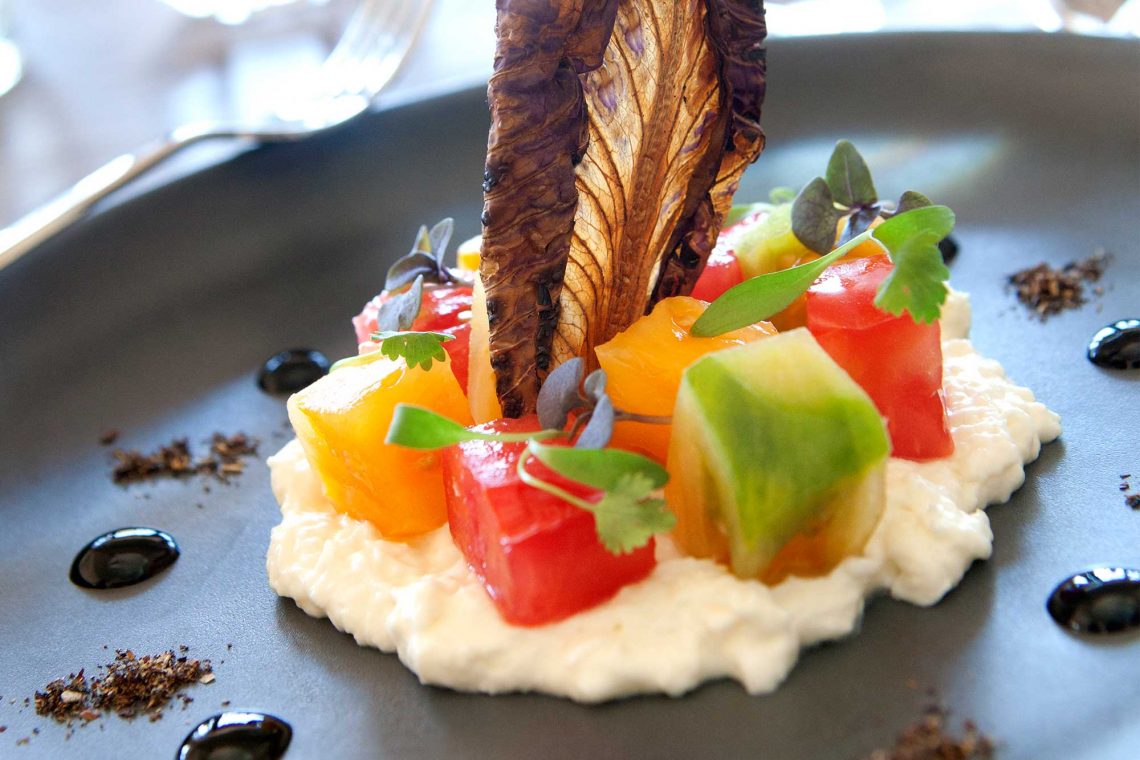 proud to present a dining experience featuring the best ingredients of California with dishes and techniques inspired by his Italian heritage.” The menu features such delights as the Ojai Farmers Market Salad; Crudo of Pacific Yellowtail with orange, fennel, Hass avocado, California sea salt and extra virgin olive oil; Cabernet Braised Short Ribs with potato fondue, cipollini onion agrodolce, heirloom carrots and black garlic; Ricotta Gnocchi with Drake Family Farms goat cheese, estate lemon, arugula and seasonal vegetables. Chef Rodella was born and raised in Guastalla, Italy. He is passionate about cooking with seasonal, market-driven ingredients.Chef Rodella’s interest in cooking started at a young age, when his passion for discovering different cuisines collided with the northern Italian fare he was raised on. He was determined to learn how to cook with fresh ingredients, uniting tradition with innovation.” This provides the traveller with a unique and delicious dining experience.
 There are plenty of fun activities around Ojai that make people came back again and again.


 The “Big Island”of Hawaii is a perfect example of a place where you can explore the vestiges of ancient civilizations and enjoy a five star experience. In Holualoa, just south of Kona lies the historic Hawaiian village
  At Pu’uhonua o Honaunau, a large wall marks the division between the royal grounds or Honaunau and the refuge quarters or Pu’uhonua. The royal grounds of Honaunau descend from the slope of Mauna Loa to the ocean, which provided the 13th century village with optimal land for farming. The location of the royal quarters on Honaunau Bay also gave residents access to fresh drinking water. Servants caught fish from the
 royal pond to serve the village ali’i (chiefs). Residents had access to the resources they needed, but travel to and from the island was not possible for villagers who did not belong to the royal court. Chiefs and their attendants were the only inhabitants of Honaunau who could use the canoe landing on the beach. To prevent villagers from using the canoes or leaving Honaunau, Ki’is (wooden images) stood around the temple of Hale o Keawe to caution residents against defying the kapu.” (From the
  resort. In 1960 Hawaii’s Governor William Quinn invited Laurance Rockefeller to visit the Big Island and scout beachfront sites for potential resorts. A noted conservationist and lover of the outdoors, Mr. Rockefeller believed that buildings should conform to, not intrude on, beautiful natural surroundings. As they flew over the white sand crescent of
  “When it opened in 1965, The Mauna Kea was the most expensive hotel ever built at the time, at $15 million. Praised by travel writers and critics worldwide, the luxury resort hotel was named one of the “Three greatest hotels in the world” by Esquire magazine, one of “10 best buildings of 1966″ by Fortune, and presented with an honors award by the American Institute of Architects.” “The original concept for The Mauna Kea luxury resort was a cluster of individual cottages along the beach-with no televisions or air-conditioning to interfere with the natural experience. In 1967. The “exorbitant” room rates started at $43, including breakfast and dinner in the Pavilion, which featured rotating menus of international cuisines.”
 Times have changed and things are always “improving”. “Following a $150 million renovation, the luxurious Mauna Kea Beach Hotel reopened in December 2008. With a fresh new expression of the unmistakable Mauna Kea style.” Nowhere is the blending of the old and new more visible than when you choose to dine at the Mauna Kea. There are five restaurants ranging from the casual to the fine dining experience. Travel first class and have an amazing grilled bone in, rib eye Paniolo steak with Hamakua Ali`i style mushrooms at the Manta or experience a traditional Hawaiian luau with imu-roasted kālua pig, fresh island fish,
  You can immerse yourself in traditional Hawaiian activities and learn how to weave
  Of course Mauna Kea has one of the finest golf courses in the world. “The stunningly beautiful and award-winning Mauna Kea Golf Course, created in 1964 by Robert Trent Jones, Sr. on a previously barren black lava field, remains an all-time favorite in beauty and design. The elevated, undulating greens and prevailing coastal winds demand accuracy. The challenging course offers stellar coastal views as it tumbles across seaside cliffs. Some holes play right alongside the ocean – or across it.”
 For thousands of years the Hawaiian people lived and recorded their lives by carving pictures in the rock in the area called Puako. Ancient Hawaiians called their stone art k’i’i pohaku, or images in stone or as we call them petroglyphs. “The field of petrogylphs can be accessed from the Holoholokai beach park in Mauna Lani Resort to the south of Puako. “The 233-acre
 amazing resorts in Hawaii. The Mauna Lani features 30 oceanfront acres and three miles of secluded shoreline. The resort has two 18-hole courses, the championship Francis H. I’i Brown North and South. Carved from ancient lava fields, the oceanside golf courses are rated among the most beautiful resort courses in the world. The Mauna Lani also features an amazing spa with nine indoor treatment
 powers of the surroundings.” Every month when the full moon rises, Mauna Lani gets ready for an enchanted evening of storytelling and entertainment on the lawn at the oceanfront Eva Parker Woods Cottage. Hotel guests,Hawaii residents, and resort employees and their families are all welcome to join Danny Akaka for “Twilight at Kalahuipua‘a,” a night of storytelling, music and perhaps a little hula.
 As one of the premier resorts in Hawaii, the
  Treat yourself to a beautiful experience at the Mauna Lani and satisfy your every whim from the world class golf course, the amazing, relaxing spa and some of the finest cuisine in all the resorts in Hawaii. Get in touch with ancient Hawaii and marvel at the Puako petroglyphs and theTwilight at Kalahuipua‘a, full moon ceremony. Travel in comfort, relax and enjoy life at the Mauna Lani.